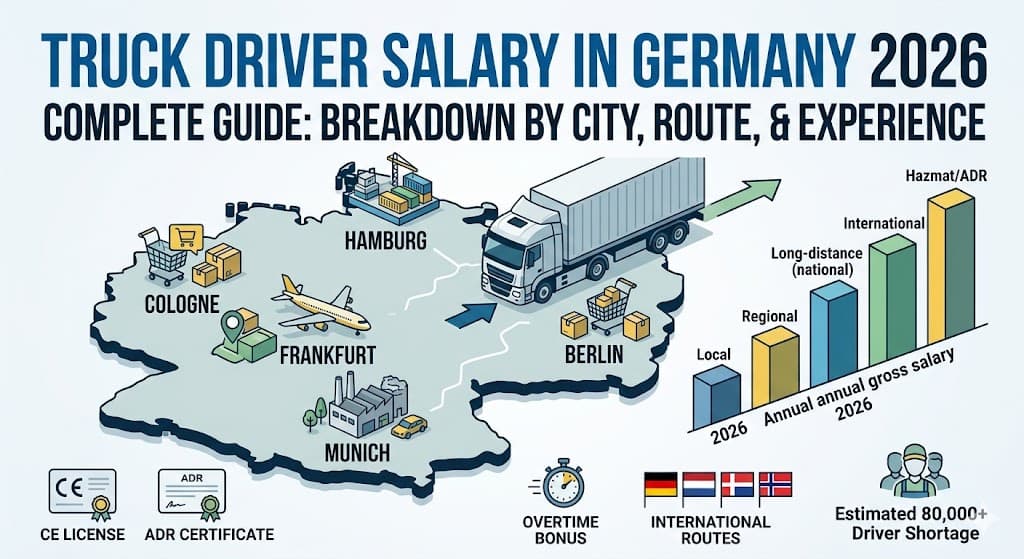
The average truck driver salary in Germany reached approximately EUR 34,800 in 2026, according to data from the Bundesagentur für Arbeit and leading transport industry reports. That figure, however, tells only part of the story. Depending on whether you drive local, regional, or international routes, your annual earnings can range from EUR 28,800 to over EUR 45,000.
Germany remains the highest-paying market for truck drivers in continental Europe. With an estimated shortage of 80,000 drivers and growing, companies are competing for qualified CE license holders, and that competition is pushing salaries upward.
Here is the complete breakdown of what you can expect to earn as a truck driver in Germany this year.
Average Salary by Route Type
Not all truck driving jobs pay the same. The type of route you drive has the biggest impact on your monthly paycheck.
| Route Type | Monthly Gross (EUR) | Annual Gross (EUR) | Notes |
|---|---|---|---|
| Local / city delivery | 2,400 – 2,800 | 28,800 – 33,600 | Home every night, lower stress |
| Regional | 2,800 – 3,200 | 33,600 – 38,400 | 1–3 overnight stays per week |
| Long-distance (national) | 3,000 – 3,500 | 36,000 – 42,000 | Multi-day trips across Germany |
| International | 3,200 – 3,800 | 38,400 – 45,600 | Cross-border routes, highest pay |
| Hazmat / ADR | 3,400 – 4,000 | 40,800 – 48,000 | Requires ADR certificate |
International drivers who handle cross-border routes between Germany, the Netherlands, and Scandinavia consistently earn at the top of the pay scale. Drivers with ADR (dangerous goods) certification can command higher salaries due to the specialized nature of the work.
Key Insight
Moving from local to international routes can increase your income by EUR 800 to EUR 1,000 per month. If you hold a CE license and are open to spending more time on the road, international routes offer the strongest earning potential.
Salary by City
Where you work matters. Germany’s major logistics hubs tend to offer higher salaries, though cost of living also varies significantly.
| City | Avg. Monthly Salary (EUR) | Key Industries | Cost of Living Index |
|---|---|---|---|
| Munich | 3,200 – 3,600 | Automotive, manufacturing | High |
| Frankfurt | 3,100 – 3,500 | Logistics hub, airport freight | High |
| Hamburg | 3,000 – 3,400 | Port logistics, international trade | Medium-High |
| Cologne | 2,900 – 3,300 | Retail distribution, FMCG | Medium |
| Berlin | 2,800 – 3,200 | E-commerce, last-mile delivery | Medium |
Each city has its own strengths. Munich and Frankfurt are key logistics hubs. Hamburg benefits from port-driven demand. Cologne and Berlin offer a strong balance between salary and cost of living.
Salary by Experience Level
Experience and certifications directly affect what companies are willing to pay.
| Experience Level | Monthly Gross (EUR) | Annual Gross (EUR) |
|---|---|---|
| Entry level (0–2 years) | 2,400 – 2,700 | 28,800 – 32,400 |
| Mid-level (3–5 years) | 2,800 – 3,200 | 33,600 – 38,400 |
| Experienced (5–10 years) | 3,200 – 3,600 | 38,400 – 43,200 |
| Senior / specialist (10+ years) | 3,500 – 4,000 | 42,000 – 48,000 |
Drivers with 5 or more years of experience who also hold ADR certification and speak basic German can expect to earn at the upper end of these ranges. Language skills are increasingly valued by German transport companies, particularly for drivers handling paperwork at border crossings and customer deliveries.
Factors That Affect Your Pay
Several factors beyond route type and experience influence how much you take home.
- CE license and additional certifications — The CE license (Class C+E) is mandatory for driving heavy goods vehicles over 7.5 tonnes with a trailer. Drivers with additional certifications like ADR, crane operation, or refrigerated transport earn premium rates.
- Overtime and night shifts — German transport companies commonly offer overtime pay at 125% to 150% of the base rate. Night shifts (between 23:00 and 06:00) typically carry a surcharge of EUR 3 to EUR 5 per hour. Based on industry averages, overtime and shift bonuses can add EUR 300 to EUR 600 to your monthly income.
- Company size — Larger logistics companies (DHL, DB Schenker, Dachser) tend to pay higher base salaries and offer better benefits. Smaller regional operators may pay less but often provide more predictable schedules and shorter routes.
- Seasonal demand — The pre-Christmas period (October to December) and harvest season see increased demand for drivers. According to Transporeon market data, spot freight prices during Christmas week can surge over 20% above contracted levels, creating short-term earning opportunities for available drivers.
Germany’s Position in the European Market
Germany is one of Europe’s largest and most active trucking markets. With over 80,000 unfilled positions, the country has one of the highest absolute driver shortages on the continent. The combination of high demand, strong labour protections under German employment law, and competitive pay makes it a particularly strong market for drivers at all experience levels.
According to IRU data, the European driver shortage continues to grow, which means qualified drivers have real leverage. Germany’s position as the EU’s largest economy and its central location for cross-border freight routes further strengthen its appeal.
What You Should Know About Cost of Living
A higher salary only matters if you keep more of it. Germany’s cost of living varies by region, and understanding this context helps you make a smarter decision about where to work.
Rent for a one-bedroom apartment ranges from EUR 500 to EUR 700 in cities like Cologne and Berlin, while Munich can cost EUR 900 to EUR 1,200. Groceries, transport, and daily expenses are relatively consistent across the country.
Many drivers choose to work international routes based out of Germany. Understanding cost of living in your chosen city helps you plan your finances effectively.
Frequently Asked Questions
The average gross salary for truck drivers in Germany in 2026 is approximately EUR 2,900 per month (EUR 34,800 annually). This varies by route type, experience, and location. International drivers with CE licenses earn up to EUR 3,800 per month.
Yes. To drive heavy goods vehicles (HGV) over 7.5 tonnes with a trailer in Germany, you need a CE license (Class C+E). The license is recognized across all EU member states. You also need a valid Driver Qualification Card (Code 95) and regular medical clearance.
Yes. EU citizens have the right to work in any EU member state. Your CE license issued in any EU country is fully recognized in Germany. Many German transport companies actively recruit drivers from across Europe and offer relocation support.
Overtime and night shift bonuses typically add EUR 300 to EUR 600 per month. Overtime rates are usually 125% to 150% of the base hourly rate. Some companies also offer performance bonuses, fuel efficiency incentives, and sign-on bonuses of EUR 1,000 to EUR 3,000 for experienced drivers.
Munich offers the highest average truck driver salaries in Germany (EUR 3,200 to EUR 3,600 per month), followed by Frankfurt and Hamburg. However, Munich also has the highest cost of living. Hamburg and Cologne offer a better balance between salary and living costs.
Find Your Next Truck Driving Job in Germany
Germany’s driver shortage means qualified drivers have real leverage in 2026. Whether you are looking for local routes with predictable hours or international runs with higher pay, the opportunities are there.
Find Truck Driver Jobs in GermanyUseful Resources
- IRU Driver Shortage Report — Global driver shortage data
- EU Driving Time Regulations — Official driving hours rules
- Eurostat Road Transport Statistics — EU freight transport data
- Bundesagentur für Arbeit — German employment agency
- BGL (German freight association) — German road haulage association
- Truck Driver Jobs in Europe — Browse jobs across 25 countries
- Hire Truck Drivers in Europe — Find verified drivers