Europe’s transport industry faces a shortage of approximately 400,000 truck drivers, according to the International Road Transport Union (IRU) 2024 report. Germany alone is short over 80,000 drivers. This shortage creates real opportunity for drivers looking to work across the continent. Cross-border hiring is growing, and non-EU drivers are increasingly entering the market through structured visa programmes.
But navigating the process requires understanding which countries are actually hiring, how license recognition works, what the visa landscape looks like, and what you can realistically expect to earn. This guide covers all of it.
Which Countries Are Hiring the Most?
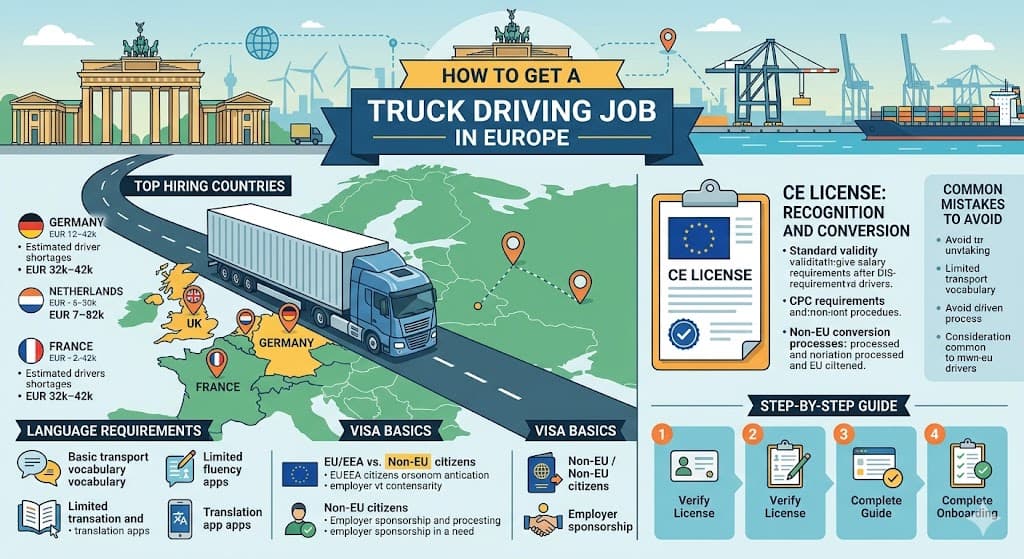
Not every European country has the same level of demand. Based on Fyndaro’s market research across 25 countries, four markets stand out for foreign drivers in 2026.
| Country | Estimated Driver Shortage | Average Annual Salary (EUR) | Hiring Demand Level |
|---|---|---|---|
| Germany | 80,000+ | 32,000 – 42,000 | Very High |
| Netherlands | 15,000+ | 30,000 – 38,000 | High |
| United Kingdom | 70,000+ | 28,000 – 40,000 (GBP equivalent) | High |
| France | 43,000+ | 26,000 – 35,000 | Moderate-High |
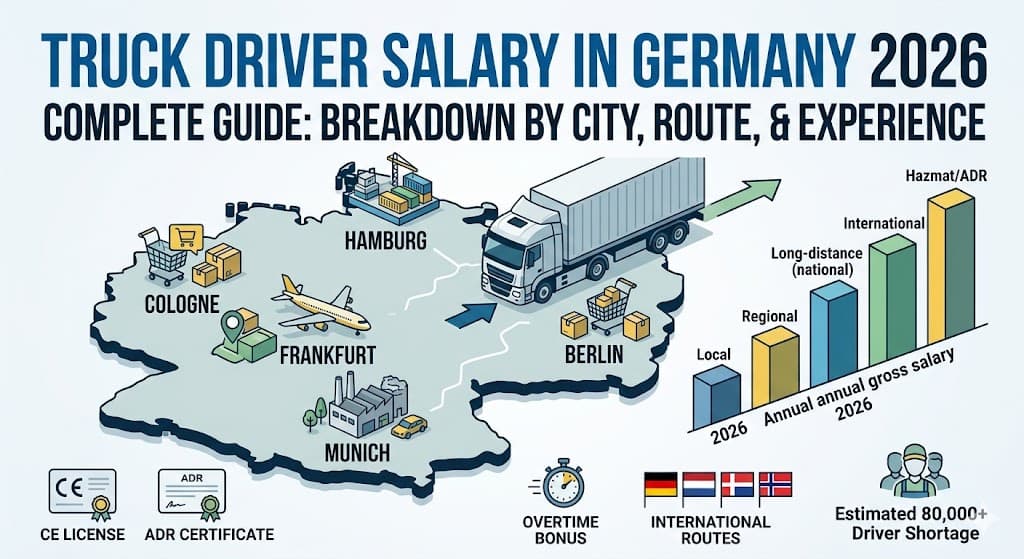
Germany leads in both shortage size and salary levels. International route drivers based in cities like Berlin, Hamburg, and Munich can earn toward the top of the range.
The Netherlands offers some of the highest hourly rates in Europe, with employers willing to pay a premium for experienced CE license holders. The country’s logistics sector, centred around Rotterdam and Amsterdam, handles a significant share of Europe’s freight.
The UK remains a major market post-Brexit, though the process for non-UK drivers now involves additional paperwork. Salaries, particularly for HGV drivers on long-haul routes, have risen sharply since the post-pandemic shortage.
France has a growing shortage and active hiring across its major logistics corridors. Lyon, Paris, and Marseille are active markets.
CE License: Recognition and Conversion Within the EU
If you hold a valid CE driving license issued in any EU or EEA member state, it is recognised across all member states. No conversion is needed. A Polish CE license works in Germany. A Romanian CE license works in the Netherlands. This is one of the EU’s biggest advantages for drivers.
Here is what you need to know by situation:
EU/EEA license holders:
- Your CE license is valid throughout the EU without conversion
- You must carry a valid Driver Qualification Card (DQC), also known as CPC (Certificate of Professional Competence)
- CPC requires 35 hours of periodic training every 5 years
- Some employers may request a local language translation of your license, but this is not legally required
Non-EU license holders:
- License recognition depends on bilateral agreements between your home country and the EU member state
- In most cases, you will need to convert your license through a local driving authority
- Germany, for example, recognises licenses from certain countries (including Turkey and select Balkan states) with a simplified exchange process
- For countries without agreements, you may need to retake parts of the practical and theory exams
- Costs for CE license conversion range from EUR 500 to EUR 3,000 depending on the country and how much testing is required
UK-specific: Since Brexit, EU licenses are valid in the UK for up to 12 months, after which you must exchange for a UK license. The process is straightforward for EU/EEA nationals.
Language Requirements: Reality vs Perception
One of the biggest misconceptions about working as a truck driver in Europe is that you need fluency in the local language. The reality is more nuanced.
What employers actually require:
- Basic communication for loading, unloading, and safety instructions
- Enough language ability to read road signs and delivery documentation
- For international routes: English is often sufficient as a working language
- For domestic routes: functional local language skills are more important
According to Fyndaro’s research across transport companies in Germany and the Netherlands, most employers prioritise driving experience and reliability over language fluency. Many Polish, Romanian, and Bulgarian drivers work successfully in Germany with limited German, using translation apps and basic phrases.
That said, drivers with local language skills earn more. German-speaking drivers in Germany, for example, tend to be assigned better routes and domestic work, which often means more home time.
The practical truth:
Key Insight
Learn basic transport vocabulary (50 to 100 words) in the language of the country where you want to work. It shows professionalism and opens more opportunities.
Visa and Work Permit Basics for Non-EU Drivers
EU and EEA citizens have the right to work in any EU member state without a visa. No work permit is needed, just registration with local authorities.
For non-EU drivers, the process varies by country:
| Requirement | EU/EEA Citizens | Non-EU Citizens |
|---|---|---|
| Work permit needed? | No | Yes (in most cases) |
| Visa required? | No | Yes (unless visa-exempt) |
| Employer sponsorship? | Not required | Usually required |
| Processing time | Immediate | 4 – 12 weeks |
| Typical costs | Registration only | EUR 100 – 500 (visa + permit fees) |
Germany introduced the Skilled Immigration Act (Fachkräfteeinwanderungsgesetz) which simplifies work visa applications for qualified truck drivers. If you have at least two years of professional driving experience and a recognised CE license, you may qualify for an expedited process.
The Netherlands uses a recognised sponsor (erkend referent) system. Transport companies registered as sponsors can hire non-EU drivers with faster processing times.
Key Insight
Always secure a job offer first. In most EU countries, employer sponsorship is required for the work permit application.
Cross-Border Opportunities
One of the most significant opportunities for drivers in Europe is cross-border employment. International routes typically offer strong earning potential, and EU freedom of movement makes the process straightforward for EU citizens: apply, get hired, start driving.
Cross-border roles typically involve international routes connecting multiple European countries, which also means more time away from home. Consider this when evaluating different positions.
What to Expect: Working Conditions and Home Time
Before committing to a truck driving job in Europe, understand what daily life looks like.
- Working hours — EU regulations limit driving time to 9 hours per day (extendable to 10 hours twice per week) and 56 hours per week. Weekly rest must be at least 45 consecutive hours. These rules are enforced through digital tachographs.
- Domestic routes — Home most nights or every other night.
- Regional/cross-border — Home every 1 to 2 weeks.
- International long-haul — Home every 2 to 4 weeks.
- Accommodation — The EU’s Mobility Package (2022) prohibits drivers from taking their regular weekly rest (45+ hours) in the cab. Employers must provide or fund suitable accommodation.
- Equipment — Most European fleets operate modern trucks (Mercedes-Benz Actros, Volvo FH, DAF XG+) with automatic transmissions, air suspension, and in-cab amenities.
Step-by-Step Guide to Getting Started
- Step 1: Verify your CE license status — Confirm whether your license is EU-issued (valid across all member states) or requires conversion. Check with your national driving authority.
- Step 2: Get your CPC/DQC — Ensure your Certificate of Professional Competence is current. If it has expired, complete the 35-hour periodic training.
- Step 3: Choose your target market — Review available jobs by country on Fyndaro to find the right fit based on your location, language skills, and route preferences.
- Step 4: Prepare key documents — Gather your CE license, CPC card, passport, medical certificate, and any prior employment references.
- Step 5: Create a driver profile — Register on Fyndaro with your qualifications, experience, preferred countries, and language skills. Companies across 25 European countries use the platform to find drivers.
- Step 6: Apply or get matched — Browse listings or let Fyndaro’s matching system connect you with companies that fit your profile.
- Step 7: Handle visa/permit (non-EU only) — Once you have a job offer, work with the employer to complete visa and work permit applications.
- Step 8: Complete onboarding — Most reputable employers provide route training, vehicle familiarisation, and administrative support for foreign drivers.
Common Mistakes to Avoid
- Paying for a job — Legitimate employers do not charge drivers recruitment fees. If someone asks for payment, walk away.
- Ignoring CPC requirements — Driving without a valid CPC can result in fines of EUR 500 to EUR 5,000 and loss of your driving privileges.
- Not checking contract details — Verify salary, working hours, home time schedule, accommodation provisions, and notice period before signing.
- Skipping language preparation — Even basic local language skills improve your job prospects and daily experience significantly.
- Using unregistered agencies — If working through a recruitment agency, verify they are registered and regulated. In the Netherlands, check the SNA register. In Germany, check Bundesagentur für Arbeit listings.
Frequently Asked Questions
Not necessarily. Many international route positions operate in English, and thousands of Polish, Romanian, and Czech drivers work in Germany with basic German skills. However, domestic routes and higher-paying positions typically require functional German. Learning basic transport vocabulary (loading, unloading, delivery terms) is strongly recommended.
For EU/EEA citizens with a valid CE license and CPC, the process can take as little as 1 to 2 weeks from application to start date. For non-EU citizens requiring a visa and work permit, expect 2 to 4 months, including document processing and employer sponsorship.
It depends on bilateral agreements between your country and the specific EU member state. Some countries (Turkey, select Balkan and CIS states) have recognition agreements with Germany and other EU nations. In other cases, you may need to convert your license, which can involve theory and practical tests costing EUR 500 to EUR 3,000.
Salaries vary significantly by country and route type. In Germany, entry-level drivers earn approximately EUR 2,400 per month, while experienced international drivers earn EUR 3,200 to EUR 3,800. In the Netherlands, expect EUR 2,500 to EUR 3,200. In Poland, domestic rates start around EUR 1,500, with international routes paying EUR 2,300 or more.
Yes. Creating a driver profile on Fyndaro is completely free. There are no fees for drivers to browse jobs, get matched, or communicate with employers.
Ready to Start?
The European truck driver shortage is not going away. If you have a CE license and professional driving experience, there are companies across 25 countries actively looking for you.
Create Your Free Driver ProfileUseful Resources
- IRU Driver Shortage Report — Global driver shortage data
- EU Driving Time Regulations — Official driving hours rules
- Eurostat Road Transport Statistics — EU freight transport data
- Bundesagentur für Arbeit — German employment agency
- BGL (German freight association) — German road haulage association
- Truck Driver Jobs in Europe — Browse jobs across 25 countries
- Hire Truck Drivers in Europe — Find verified drivers